











Our capabilities are growing. Tell us how we can help you.
New Developments in Industrial IoT Hardware and Embedded Electronics
Industrial IoT is moving beyond connectivity as a feature and becoming embedded infrastructure within manufacturing, utilities, transport and critical systems. As deployment accelerates, expectations around reliability, lifecycle performance, security and scalability are increasing. The conversation is no longer centred on connected devices, but on robust industrial IoT hardware capable of operating predictably in demanding environments.
Recent industrial IoT developments are therefore occurring primarily at hardware and embedded electronics level. Advances in low-power design, RF architecture, hardware-based security, edge computing and design for manufacturability are reshaping how connected products are engineered and produced. Devices must now be secure by design, energy-efficient, compliant with regulatory standards and capable of scaling from prototype to full production without redesign.
For startups entering industrial markets and established manufacturers modernising existing systems, understanding these developments is essential. The transition from concept to manufacturable, production-ready hardware is becoming one of the defining challenges of the industrial IoT era.
Contents
- The Evolution of Industrial IoT Hardware in Manufacturing
- Key Industrial IoT Developments in Low-Power Hardware Design
- Connectivity Developments Shaping Industrial IoT Devices
- Hardware-Level Security in Industrial IoT Systems
- Design and Manufacturing Considerations for Industrial IoT PCB Assembly
- Edge Computing Developments in Industrial IoT Hardware
- Scaling Industrial IoT Hardware from Prototype to Production
- Industrial IoT Developments and the Future of UK Electronic Manufacturing
The Evolution of Industrial IoT Hardware in Manufacturing
Industrial IoT has evolved significantly from its consumer origins. Industrial systems demand higher resilience, longer operational lifespans and stricter compliance standards.
Differences Between Consumer IoT and Industrial IoT Hardware Requirements
Consumer IoT prioritises rapid innovation and user experience. Industrial IoT hardware must withstand vibration, temperature variation, electrical interference and continuous operation. The engineering tolerances are tighter, and failure carries greater operational consequences.
Reliability and Lifecycle Expectations in Industrial IoT Devices
Industrial deployments often require devices to operate reliably for five to ten years. Component stability, thermal management and long-term supply planning are now critical design considerations rather than afterthoughts.
Compliance and Environmental Standards for Industrial IoT Systems
Industrial IoT devices must meet EMC, safety and environmental standards aligned with recognised industry frameworks such as IPC electronic manufacturing standards.
Key Industrial IoT Developments in Low-Power Hardware Design
Power efficiency is a defining theme in modern industrial IoT hardware.
Ultra-Low-Power Microcontrollers for Industrial IoT Devices
Microcontroller architectures are increasingly optimised for sleep cycles and minimal current draw, extending battery life in remote deployments.
Power Management IC Selection for Long-Life IoT Devices
Advanced power management ICs allow precise voltage regulation and energy optimisation, improving operational lifespan and reducing maintenance intervals.
Designing Energy-Efficient PCB Layouts for Industrial IoT
Trace routing, grounding and component placement all influence energy efficiency. Careful PCB design reduces leakage and improves long-term reliability.
Connectivity Developments Shaping Industrial IoT Devices
Connectivity choices now significantly influence hardware architecture.
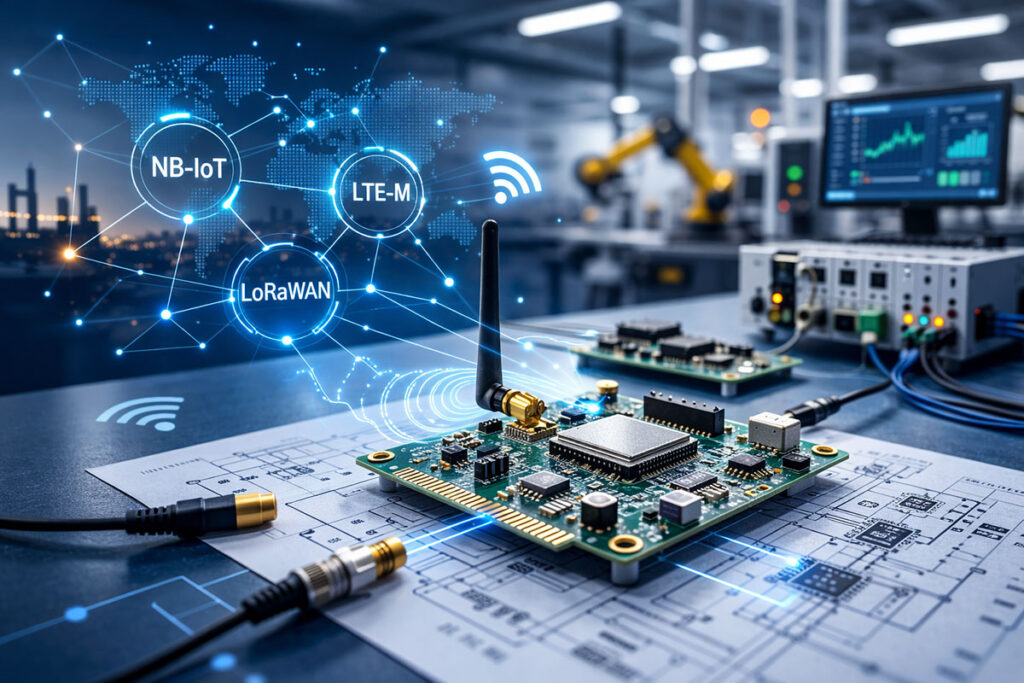
Industrial IoT connectivity technologies enabling secure wireless communication between embedded electronic devices and manufacturing systems.
NB-IoT, LTE-M and LoRaWAN in Industrial Applications
Low-power wide-area technologies enable long-range communication while preserving battery life. Selecting the correct protocol depends on bandwidth, coverage and environmental constraints. These cellular IoT technologies operate within globally defined connectivity ecosystems supported by organisations such as the GSMA IoT programme.
RF PCB Layout Considerations for Industrial IoT Hardware
Antenna positioning, impedance control and ground plane design directly affect signal integrity. Industrial environments require robust RF performance under interference conditions.
EMC and Signal Integrity in Connected Industrial Devices
Electromagnetic compatibility compliance is essential in industrial settings. PCB design must mitigate noise and maintain stable communication across connected systems.
Hardware-Level Security in Industrial IoT Systems
Security is now embedded at board level rather than applied purely through software.
Secure Boot and Hardware Encryption in IoT Devices
Secure boot mechanisms prevent unauthorised firmware execution. Hardware encryption modules protect sensitive data during transmission and storage.
Trusted Platform Modules in Industrial Embedded Systems
Trusted hardware components enhance device authentication and integrity, supporting compliance requirements in regulated sectors.
Protecting Firmware Integrity in Production IoT Hardware
Manufacturing processes must support secure firmware loading and traceability to maintain system integrity at scale.
Design and Manufacturing Considerations for Industrial IoT PCB Assembly
As devices become more capable, manufacturability becomes increasingly important.
Designing PCBs for Manufacturability in Industrial IoT
Design for manufacturability reduces assembly complexity and improves yield rates. Early collaboration between design and production teams helps prevent costly redesigns.
Thermal Management Strategies in High-Density IoT Boards
Edge processing and integrated intelligence increase thermal loads. Copper balancing, vias and component spacing all contribute to effective heat dissipation.
Component Selection and Obsolescence Planning for Long-Term Deployment
Industrial IoT products often require extended availability. Selecting components with stable lifecycle forecasts reduces the risk of mid-production redesign.
Edge Computing Developments in Industrial IoT Hardware
Industrial IoT devices are increasingly processing data locally.

Edge computing hardware enabling real-time data processing and intelligent decision-making within industrial IoT manufacturing systems.
On-Device Data Processing in Industrial IoT Systems
Edge computing reduces latency and reliance on cloud infrastructure. Devices can analyse and act on data in real time.
AI Acceleration and Embedded Intelligence at the Edge
Integrated processing power enables predictive analytics and condition monitoring directly within the device.
Balancing Processing Power with Thermal and Power Constraints
Higher performance must be balanced with energy efficiency and heat management to maintain reliability.
Scaling Industrial IoT Hardware from Prototype to Production
Transitioning from prototype to production remains one of the most significant challenges.
Common Manufacturing Challenges in Industrial IoT Devices
Thermal loads, RF interference and compliance testing frequently expose issues not visible in early prototypes.
Transitioning from Prototype PCB to Volume Assembly
Scaling requires careful supply chain planning, component sourcing and process validation to maintain consistency at volume.
Quality Control and Traceability in Industrial IoT Manufacturing
Industrial markets demand rigorous inspection and testing and traceability to support reliability and regulatory compliance.
Industrial IoT Developments and the Future of UK Electronic Manufacturing
Industrial IoT is maturing from innovation to infrastructure. Devices are no longer experimental enhancements but core components of operational systems.
For UK manufacturers, this creates both opportunity and responsibility. Connected products enable improved monitoring, predictive maintenance and data-driven optimisation. At the same time, hardware must be secure, compliant, power-efficient and scalable from the outset.
As industrial IoT developments continue to reshape embedded electronics, the gap between concept and production-ready hardware is narrowing. Manufacturers who understand low-power design, RF performance, security integration and scalable electronic assembly are better positioned to support the next phase of connected industrial systems.
Industrial IoT hardware is becoming foundational to modern manufacturing infrastructure. The organisations that align engineering design with production capability will define its next stage of growth.
Enquire about Electronic Assembly
0161 626 4117